

Nano Microporous Insulation for Steel Ladles
Product Description:
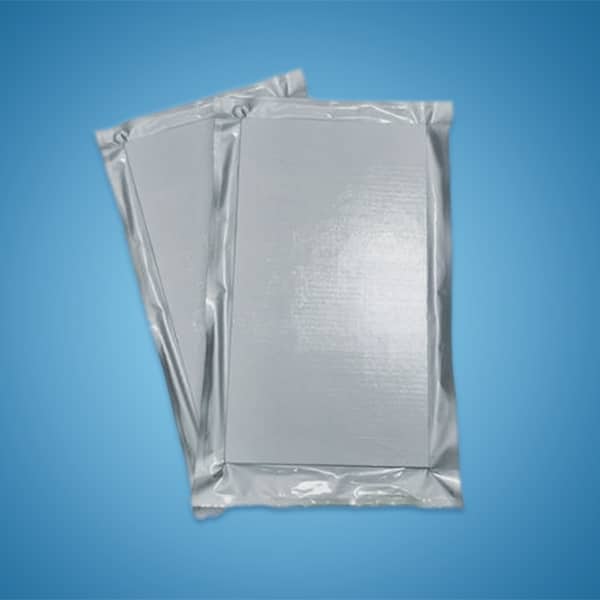
Nano Microporous Insulation for Steel Ladles is a nano microporous thermal insulation material specially designed for steel metallurgical industry, such as ladle. Its thickness is relatively thin, usually 3-10 mm. Vacuum-packaged with an aluminum foil composite film, it can be properly bent and has good compressive strength. Using aluminum foil to wrap can enhance certain strength, and play a dustproof and waterproof role in installation. This product has excellent compressive strength and heat insulation performance, and is convenient and quick to install and construct.
Specifications:
Size(mm): | 500×610mm;300×500mm | Thickness(mm): | 3,5,7, |
Operating temperature(℃) | 1000 (continuous),1200 (classification) | Density (kg/m3): | 280-320, customizable |
Thermal conductivity: W/mK T/C (YB/T4130-2005)
200℃ | 0.021 |
400℃ | 0.025 |
600℃ | 0.028 |
800℃ | 0.034 |
Product advantages:
- The thermal insulation performance is 3~4 times that of traditional materials, which can greatly reduce the energy consumption of equipment and reduce the required thickness of insulation layer.
- Small specific heat, low heat storage, heat shock resistance.
- Temperature resistance up to 1200 ℃
- It can effectively block infrared radiation
- No pulverization, long service life.
- It is non-toxic and environmentally friendly, does not contain inhalable harmful fibers, smokeless and odorless when heated, and does not itch when touching the skin. It can be used for household appliances.
- Woodworking tools can be used for cutting, drilling and other processing.
- This product is a non combustible material, which can be used as a fire insulation layer.
Typical Application:
- Ladle
- Tundish
- Torpedo tank
- cement kiln
Frequently Asked Questions about Nano Microporous Insulation for Steel Ladles
Quick answers to common technical and commercial questions engineers and procurement teams ask about our Nano Microporous Insulation for Steel Ladles. For specifications not covered here, please contact our technical team.
For sample requests, lead times, and shipping terms, see the Products page FAQ.
Technical Specifications
| Parameter | Value |
|---|---|
| Maximum Service Temperature | 1000 °C |
| Thermal Conductivity | 0.020 W/(m·K) at 25 °C |
| Standard Width | 1000 / 1200 |
| Standard Thickness | 20 / 25 / 30 / 40 / 50 |
| Density | 220–280 kg/m³ |
| Compressive Strength @10% deformation | ≥ 0.35 MPa |
| Dimensional Tolerance | ±2 mm (length), ±1 mm (thickness) |
| Minimum Order Quantity (MOQ) | 5 m³ or 100 pieces |
| Lead Time | 10–25 working days depending on configuration |
| Packaging | Standard export wooden crate or pallet; vacuum-sealed PE film interior |
| Quality Standard | YB/T 4130-2005, EN 13501-1 (fire classification A1) |
Why Engineers Choose Steel Ladles Microporous Insulation
The steel-ladle-grade nano microporous insulation board is a high temperature insulation panel purpose-engineered as ladle backup behind refractory working linings — reducing ladle heat loss by 30–50 %.
A fumed silica microporous core (optionally paired with a thin ceramic-fiber expansion layer) provides microporous thermal insulation that survives 12–24 months of thermal cycling between ladle turn-arounds.
Steel mills specifying this microporous insulation panel for 150-ton and larger ladles report shell temperature reductions of up to 60 °C — measurable savings on ladle shell cooling water demand and refractory lifetime.
Related Products
Engineers who specified this Nano Microporous Insulation for Steel Ladles also reviewed:
- Standard Nano Microporous Insulation Board
The microporous core panel used behind ladle working refractory
- Aluminum Foil-Faced Nano Microporous Insulation Board
Add a 0.05 mm Al-foil skin when moisture or shell-side condensation is a concern
- Industrial Applications of Microporous Insulation
Steel Ladles application case — 12 to 24-month service life achieved
Browse our full nano microporous insulation product line, or read our technical guide on microporous thermal insulation principles. Need help selecting the right board? Contact our engineering team.
Quality & Certifications
Every batch of our nano microporous insulation is produced under a documented quality system and released with traceability paperwork. Third-party test reports and certificates are available on request for engineering submittals and tender packages.
- ISO 9001:2015 — Quality Management System certification for design, production, and after-sales service.
- REACH Compliance — Registration, Evaluation, Authorisation and Restriction of Chemicals — full declaration on file.
- RoHS 2.0 Compliance — Restriction of Hazardous Substances — third-party tested for heavy metals and phthalates.
- Asbestos-Free Declaration — Certified asbestos-free per WHO and OSHA material safety data sheets.
- YB/T 4130-2005 — Chinese metallurgical industry standard for microporous insulation boards.
- EN 13501-1 Fire Classification A1 — Non-combustible per European reaction-to-fire test.
- SGS Test Reports — Density, compressive strength, thermal conductivity, and loss-on-ignition — third-party verified.
- CE Marking — EU Declaration of Conformity for the relevant product families.
Certificate Gallery (Documentation on Request)
High-resolution scans of certificates and test reports are available — request our documentation pack to receive PDF originals.
Related Applications
See how this product performs in real installations:
Related Application Notes
More steel plant insulation engineering data: insulation thickness calculation for ladles, RH vacuum degasser insulation, tundish insulation, torpedo ladle insulation, ladle preheat energy savings.
 English
 German
 Chinese (China)
 Korean
 Japanese
 Spanish
 French
 Italian
 Turkish
 Vietnamese
 Portuguese
 Hindi
 Arabic
 Polish
 Chinese (Taiwan)