
















Glass Fiber Fabric-Faced Nano Microporous Insulation Board
Product Description:
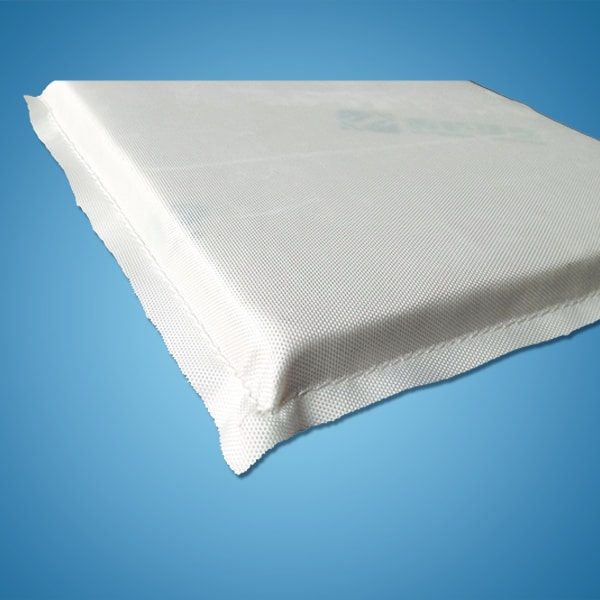
Glass Fiber Fabric-Faced Nano Microporous Insulation Board is a nano microporous thermal insulation board with high-temperature-resistant glass fiber fabric laminated on the surface of the standard nano microporous board, which shows excellent thermal insulation performance at high temperature. The high-temperature resistant glass fiber cloth increases the strength of the nano-board, and almost no dust can be realized during construction and taking. This product has very good cutting characteristics and is easy to be cut by tools such as knives and saws. Glass fiber fabric-faced nano microporous insulation board can be fixed by glue or anchor. This material has advanced technology, high economic benefit and excellent flame retardant performance. Customers can customize the thickness of 5-50mm according to the use situation.
Specifications:
Size(mm): | customizable |
Thickness(mm): | 5~50 |
Classification temperature(℃) | 900,1000,1200 |
Density: (kg/m3), | 200~320, customizable |
Thermal conductivity: W/mK T/C (YB/T4130-2005)
200℃ | 0.022 |
400℃ | 0.024 |
600℃ | 0.029 |
800℃ | 0.036 |
Product advantages:
- The thermal insulation performance is 3~4 times that of traditional materials, which can greatly reduce the energy consumption of equipment and reduce the required thickness of insulation layer.
- Small specific heat, low heat storage, heat shock resistance.
- Temperature resistance up to 1100 ℃
- It can effectively block infrared radiation
- No pulverization, long service life.
- It is non-toxic and environmentally friendly, does not contain inhalable harmful fibers, smokeless and odorless when heated, and does not itch when touching the skin. It can be used for household appliances.
- Woodworking tools can be used for cutting, drilling and other processing.
- This product is a non combustible material, which can be used as a fire insulation layer.
Typical Application:
- Thermal storage heater
- Elevator landing door
- fire-proof door
- Heat treatment furnace
- Glass furnace
- Incinerator
- heating furnace
Frequently Asked Questions about Glass Fiber Fabric-Faced Nano Microporous Insulation Board
Quick answers to common technical and commercial questions engineers and procurement teams ask about our Glass Fiber Fabric-Faced Nano Microporous Insulation Board. For specifications not covered here, please contact our technical team.
What are the benefits of glass fiber fabric facing on microporous insulation boards?
Is glass fiber fabric facing heat-resistant?
Can glass fiber-faced board withstand vibration and mechanical stress?
Is glass fiber fabric facing environmentally friendly?
How does it compare with aluminum foil facing?
What temperature range can glass fiber-faced boards handle?
Technical Specifications
| Parameter | Value |
|---|---|
| Maximum Service Temperature | 950 °C |
| Thermal Conductivity | 0.020 W/(m·K) at 25 °C |
| Standard Width | 1000 / 1200 |
| Standard Thickness | 10 / 15 / 20 / 25 / 30 |
| Density | 220–280 kg/m³ |
| Compressive Strength @10% deformation | ≥ 0.35 MPa |
| Dimensional Tolerance | ±2 mm (length), ±1 mm (thickness) |
| Minimum Order Quantity (MOQ) | 5 m³ or 100 pieces |
| Lead Time | 10–25 working days depending on configuration |
| Packaging | Standard export wooden crate or pallet; vacuum-sealed PE film interior |
| Quality Standard | YB/T 4130-2005, EN 13501-1 (fire classification A1) |
Why Engineers Choose Glass Fiber Fabric-Faced Microporous Insulation
Glass fiber fabric-faced nano microporous insulation board is our most mechanically robust high temperature insulation panel — an E-glass or S-glass woven fabric covers both faces of the fumed silica microporous core.
The fabric skin tolerates vibration, abrasive dust, and incidental foot traffic that would tear aluminum foil or PE film — extending service life of the microporous thermal insulation in petrochemical, marine, and mobile equipment.
Specifying this microporous insulation panel for pipework carrying thermal cycling or rotating equipment housings gives maintenance teams a skin that can be wiped clean and inspected between outages.
Related Products
Engineers who specified this Glass Fiber Fabric-Faced Nano Microporous Insulation Board also reviewed:
- Standard Nano Microporous Insulation Board
Unfaced base board — same microporous core for installations where facing is unnecessary
- Custom-Shaped Nano Microporous Insulation
Three-dimensional formed parts for complex geometries
- Industrial Applications of Microporous Insulation
See where glass-fiber-faced board excels in petrochemical service
Browse our full nano microporous insulation product line, or read our technical guide on microporous thermal insulation principles. Need help selecting the right board? Contact our engineering team.
Quality & Certifications
Every batch of our nano microporous insulation is produced under a documented quality system and released with traceability paperwork. Third-party test reports and certificates are available on request for engineering submittals and tender packages.
- ISO 9001:2015 — Quality Management System certification for design, production, and after-sales service.
- REACH Compliance — Registration, Evaluation, Authorisation and Restriction of Chemicals — full declaration on file.
- RoHS 2.0 Compliance — Restriction of Hazardous Substances — third-party tested for heavy metals and phthalates.
- Asbestos-Free Declaration — Certified asbestos-free per WHO and OSHA material safety data sheets.
- YB/T 4130-2005 — Chinese metallurgical industry standard for microporous insulation boards.
- EN 13501-1 Fire Classification A1 — Non-combustible per European reaction-to-fire test.
- SGS Test Reports — Density, compressive strength, thermal conductivity, and loss-on-ignition — third-party verified.
- CE Marking — EU Declaration of Conformity for the relevant product families.
Certificate Gallery (Documentation on Request)
High-resolution scans of certificates and test reports are available — request our documentation pack to receive PDF originals.
Related Applications
See how this product performs in real installations: